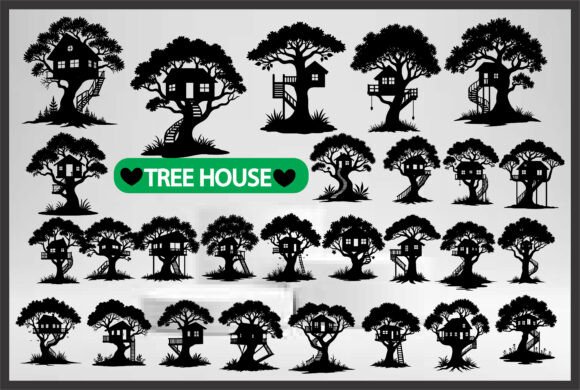
Fantasy Tree Home Vector Collection: A Designer's Review
As a designer who spends more time staring at stitch maps than most people care to admit, I am always skeptical when I see a new bundle labeled as "perfect for everything." Recently, I got my hands on the Fantasy Tree Home Vector Collection, a set of 27 tree house silhouette designs. While the product listing categorizes these under Freebies and Graphics, my immediate instinct was to look past the marketing fluff and determine if these shapes could actually survive the transition from a digital screen to a piece of fabric under a needle. The promise of clean black style is enticing, but in the world of machine embroidery design, clean lines on a monitor do not always translate to clean stitches on a garment.
The First Impression: Mood and Silhouette
Opening up the files, the first thing that strikes me is the whimsical yet grounded mood of the collection. These aren't just generic trees; they are homes, nestled into trunks with varying degrees of architectural fantasy. The silhouettes are bold, which is a double-edged sword for an embroiderer. On one hand, strong shapes make for excellent finished product recognition from a distance. On the other hand, solid black areas in embroidery can easily become dense blobs of thread if not handled correctly. The visual personality here leans heavily toward storybook illustrations, making it an ideal candidate for nursery decor or boutique branding that aims for a cozy, handmade feel.
For an Etsy seller or small shop owner, the variety within the 27 designs is a significant asset. You have tall, slender trees that work well for vertical placements on aprons or tote bags, and wider, sprawling canopies that could anchor a pillow cover or a sweatshirt chest patch. However, because these are vector-based graphics originally intended for printing and laser cutting, the conversion to a usable embroidery file requires a critical eye. You cannot simply import these and hit start; you must consider how the stitch density will behave.
Real-World Application: The Custom Tote Bag Scenario
To truly test the viability of the Fantasy Tree Home Vector Collection, I envisioned a specific real-life scenario: creating a custom embroidered tote bag for a local farmer's market vendor. The client wanted a logo that felt organic and sustainable. One of the tree house silhouettes seemed perfect. The shape was distinct, and the "home" aspect aligned with the vendor's brand of community.
In this context, the design shines as a potential applique design. If I were to fill the entire silhouette with a fill stitch, the resulting stiffness might make the canvas bag difficult to fold or use. Instead, using the vector outline as a guide for a thick satin stitch border with a lighter fabric fill inside would maintain the aesthetic while keeping the fabric texture manageable. This approach turns a graphic into a tactile handmade product that customers love to touch. For a personalized gift, adding a small name in a simple font beneath the tree house could elevate the item from a generic craft to a cherished keepsake.
Performance on Different Fabrics and Items
When considering where these designs fit best, the list of potential applications is long, but so are the caveats. For custom apparel like sweatshirts or hoodies, the thicker fabric provides a stable base for the potentially dense stitching required to fill these silhouettes. A sweatshirt embroidery project using one of the larger tree houses on the back yoke could look stunning, provided the stabilizer is heavy enough to prevent puckering.
However, caution is needed with thinner materials. If you attempt to stitch these onto a lightweight baby onesie for baby embroidery, the weight of the thread could distort the garment. In such cases, these designs are better suited as printed mockups or applied as patches rather than direct stitching. Similarly, for holiday embroidery on kitchen towels or tea towels, the looped texture of terry cloth can swallow fine details. The clean black style of the Fantasy Tree Home Vector Collection helps here, as high-contrast shapes tend to read better on textured surfaces than intricate, multi-colored scenes.
Curved surfaces present another challenge. Placing a detailed tree house on the front panel of a cap requires careful digitizing. The center of the design must be free of large continuous runs that might pull across the curve of the brim. For an embroidered patch, however, these designs are nearly ideal. The defined edges allow for a clean merrowed or satin border, creating a professional-looking accessory that can be ironed onto jackets or bags.
Critical Considerations for Commercial Use
Before rushing to list these as part of your craft business inventory, there are technical hurdles to clear. Since the source material is described as a vector collection for printing and laser cutting, it is highly likely that these are not ready-to-stitch digital embroidery files out of the box. You may need to digitize them yourself or hire a professional to convert the vectors into a format your machine understands, defining the stitch types (running stitch, satin stitch, or fill stitch) manually.
If you are using these as design assets for a print-on-demand service or laser cutting, the workflow is straightforward. But for embroidery, you must verify the hoop size compatibility. Some of the taller trees in the collection might exceed standard 4x4 or 5x7 hoops, requiring a re-digitization to split the design or scale it down without losing definition. Tiny windows or door details in the tree houses might vanish if the design is reduced too much for a small embroidery project.
Furthermore, licensing is paramount. Even though these are listed under Freebies, the terms for commercial embroidery can differ from those for digital printing. Always confirm whether you are allowed to sell the finished product or if the license restricts you to personal use only. This step protects your small shop product line from legal issues down the road.
Final Verdict and Practical Tips
The Fantasy Tree Home Vector Collection offers a charming aesthetic that fits perfectly into the current trend of cottage-core and nature-inspired goods. Its strength lies in its versatility as a visual concept for commercial embroidery, nursery decor, and branded merchandise. However, its success depends entirely on the execution.
Here are my top recommendations for anyone planning to use these designs:
- Test on Scrap First: Never stitch directly onto your final garment. Test the density and pull on a scrap piece of the same fabric.
- Check Contrast: Ensure your thread colors pop against the fabric. Black thread on navy blue might look muddy; consider using dark charcoal or deep green for better definition.
- Stabilizer is Key: Use a cut-away stabilizer for stretchy fabrics like t-shirts to prevent the design from distorting after washing.
- Simplify Details: If digitizing yourself, remove tiny internal details that the needle cannot physically reproduce.
- Verify Licensing: Double-check the terms regarding selling items made from these graphics.
In conclusion, while the Fantasy Tree Home Vector Collection starts as a set of graphics, with the right technical approach, it transforms into a powerful tool for creating memorable, high-value embroidered goods. It rewards the designer who takes the time to adapt the image to the medium, resulting in a product that feels both magical and professionally crafted.